UTV Wheel Offset Guide
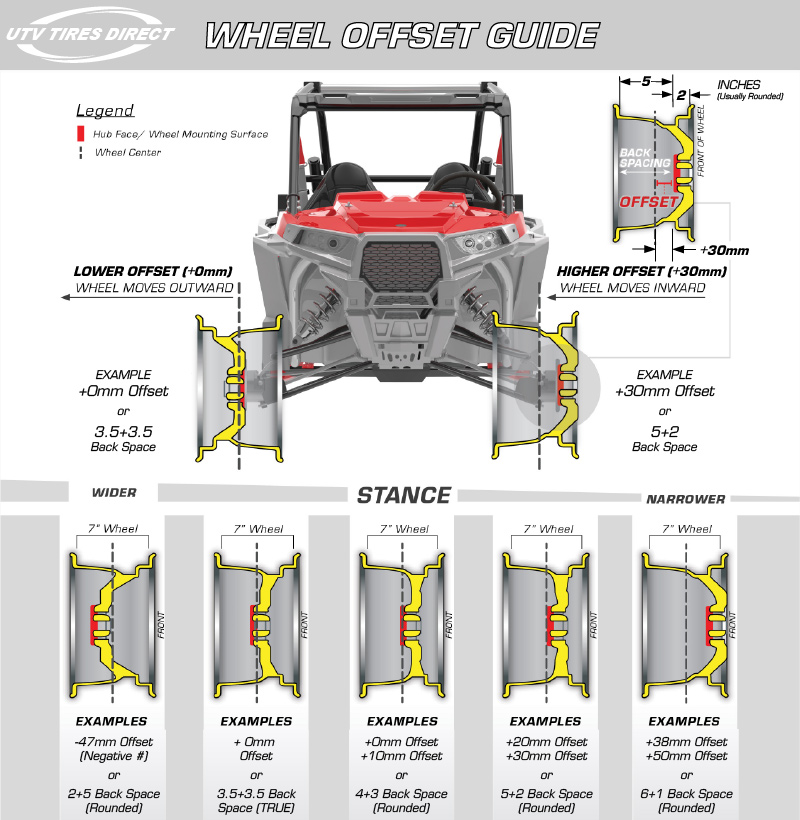 Wheel Offset Back Spacing Guide
Two Terms - Offset and Backspacing. What do they mean?
Offset and backspacing are two different terms essentially describing the same thing, but referencing different locations of the wheel. The two terms are interlinked and often interchanged with each other, as they determine the location of the wheel position relative to the hub, but what are they exactly?
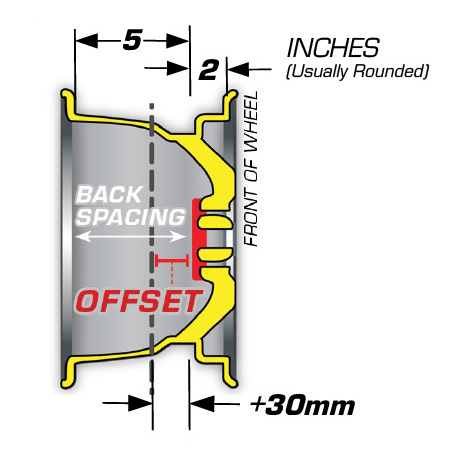 Wheel Offset vs Back Spacing
Wheel Offset
Offset is the measurement from the wheel’s mounting surface to the theoretical center line of the
wheel. This measurement is stamped on the back of most wheels as 'ET' and a number, typically stated in millimeters (mm). Examples include: -47mm / 0mm / +5mm / +10mm / +30mm / +38mm / +50mm.
- The higher the offset (or more positive the number), the further inward the wheel is positioned on the vehicle (more narrow stance).
- Likewise, the lower the offset (or lower the number, can even be negative), the wider the stance.
- Example: When comparing two wheels with different offset, one with +5mm and the other with +30mm offset, the +5mm offset wheel will widen the stance about 1" per side (2" overall).
Backspacing
Backspacing describes the amount of offset in a wheel, but uses different reference points, namely the inside and outside wheel flanges instead of the wheel centerline. Backspacing is measured from the ‘inside rim flange’ to the ‘mounting face’ (1st number) and the ‘outside rim flange’ to the ‘mounting face’ (2nd number). This number is typically stated in inches, often times rounded to the nearest whole numbers. When the inside and outside numbers are added together, the sum equals the bead-to-bead distance of the wheel. Examples include 6+1, 5+2 and 4+3.
- Backspacing of 4+3, 5+2 or 6+1 all indicate a 7” wide wheel from ‘inside bead’ to ‘outside bead’ (The overall width from ‘outside edge’ to ‘outside edge’ would be ~8“).
- 4+3 means 4" from the inside flange (toward suspension) to the mounting face, 3" from the outside flange (toward fender) to the mounting face
- 5+2 means 5" from the inside flange to the mounting face, 2" from the outside flange to the mounting face
- Backspacing numbers are also typically rounded to the nearest inch
- Example: When comparing two wheels with different backspacing, one with a 4+3 and the other with 5+2, the 4+3 backspacing will extend further outward about 1" per side (2" overall).
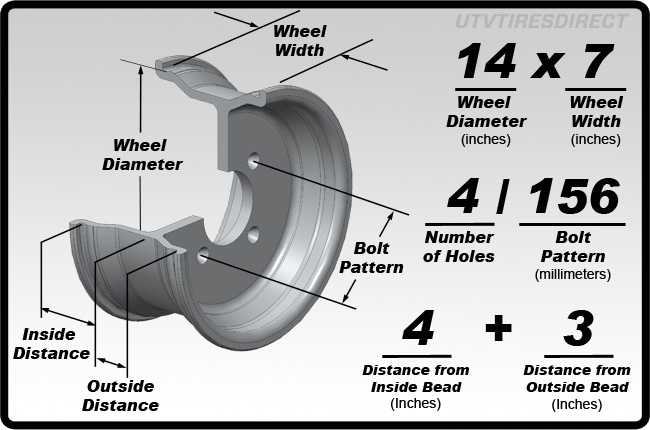 Wheel Backspacing
Notes / Disclaimer
Offset and/or backspacing measurements are determined by the wheel manufacturers. While the terms are interlinked, some DISCREPANCIES exist between the two terms. Particularly, published backspacing numbers may not be consistent for a given offset between different manufacturers since backspacing 1) may be rounded to a whole number and 2) may reference the rim edges instead of rim flanges or vice versa. The information provided here is designed to provide a general overview and description of offset and backspacing.
Changing from OE (Original Equipment) specifications can cause clearance issues. When installing different wheels, check clearances at all suspension positions.